
Nursing in Canada - HHR and SPEP for IEN
-
Transcript
MICHELLE DUMONT
Health Human Resources are programs in Ontario that are throughout different facilities and health organizations. And what they do is they help to attract, educate, train, and retain talent at the hospital and throughout Ontario. So Health Human Resources in Ontario started around 1960 with the Underserviced Area Program. That program was to help and retain talent in the North. In the year 2000, Northern Health Human Resources programs expanded to include Grow the North, as well as the Northern Ontario School of Medicine. The new Graduate Guarantee Program helps our nurses to transition to full-time practice with the help of a mentor. Around 2020, Queensway Carleton Hospital welcomed the Clinical Extern Program, the Clinical Scholar Program, as well as our SPEPs, Supervised Practice Experience Partnership. The reason why HHR matters here at Queensway is that every year, Ontario requires thousands of skilled workers to enter the healthcare workforce. HHR programs help to support and train new healthcare professionals. They support learning and growth and keep great healthcare professionals working in Ontario
Nursing In Canada
In 2022, QCH launched the Supervised Practice Experience Program (SPEP) for Internationally Educated Nurses (IEN). Rodolfo Cabrales is one of the nurses who has benefited from this program. In the video above, he shares his journey pursuing a nursing career in Canada and how QCH supported him in achieving his professional goals.
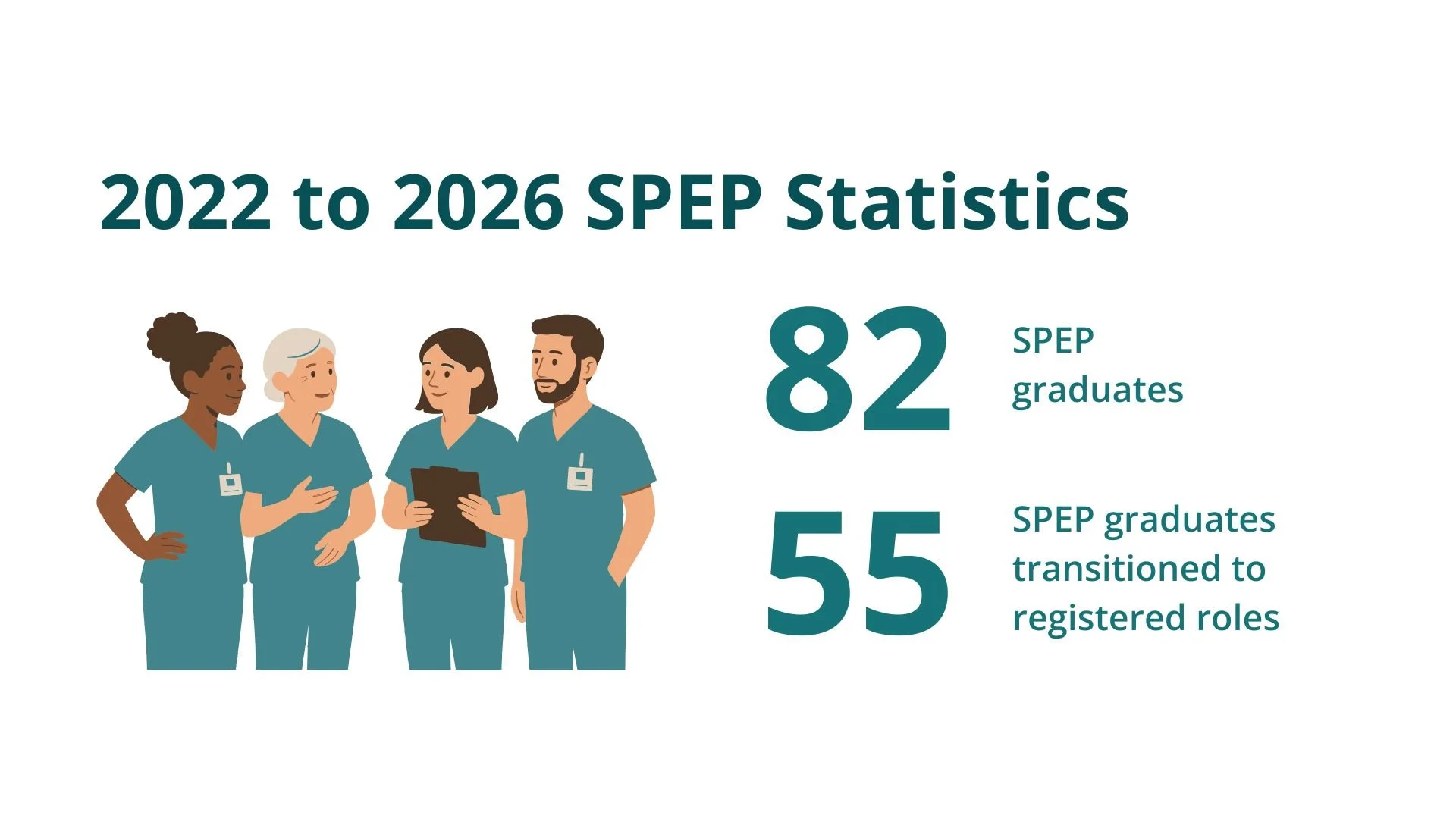
An infographic titled "2022 to 2026 SPEP Statistics." The left side features an illustration of four healthcare workers in teal scrubs talking. The right side displays two key statistics in large teal font: "82 SPEP graduates" and "55 SPEP graduates transitioned to registered roles."
Strengthening Ontario’s Healthcare Workforce
Michelle Dumont, Health Human Resources Program Coordinator, takes us through the origins of Health Human Resources (HHR) and its role in strengthening Ontario’s healthcare workforce. HHR has supported key programs such as the Clinical Extern program, the Clinical Scholar program, and the Supervised Practice Experience Program for Internationally Educated Nurses.
Meet Karen Regalado
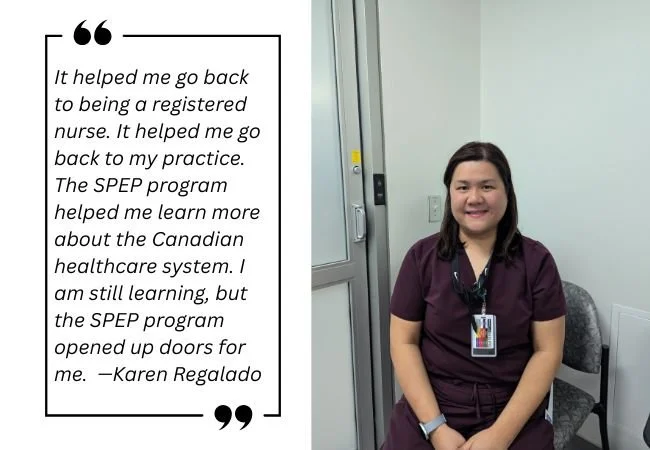
A testimonial graphic featuring a photo of Karen Regalado, a woman with dark hair wearing maroon medical scrubs and a hospital ID badge, sitting in a room. To her left is a large pull-quote that reads: "It helped me go back to being a registered nurse. It helped me go back to my practice. The SPEP program helped me learn more about the Canadian healthcare system. I am still learning, but the SPEP program opened up doors for me. —Karen Regalado"
Karen Regalado (Nurse, Medical-Surgical Inpatient) successfully completed the SPEP for IEN. In the interview below, she talks about how SPEP helped her get back into nursing and build her career in Canada.
Q: Can you tell us about your journey to becoming a registered nurse in Canada?
I’m originally from the Philippines and moved to Canada in 2018. I was a registered nurse back home before immigrating. After arriving in Canada, I completed the Registered Practice Nurse (RPN) program, which took four to five years. When I passed the NCLEX, the College of Nurses of Ontario (CNO) required me to complete SPEP to be a registered nurse.
QCH was suggested as an option, so I applied — and that’s where it started.
Q: How did SPEP help you adjust to differences in nursing practice in Canada and the Philippines?
There are many procedures and protocols that are very different from back home to here. One advantage of going through SPEP is that it allows you to become familiar with these changes in a supportive environment. Even smaller things — like supplies and equipment — are different, so SPEP helps you re-familiarize yourself with everyday practice in Canada.