
Opening of the COVID-19 Vaccine Clinic

-
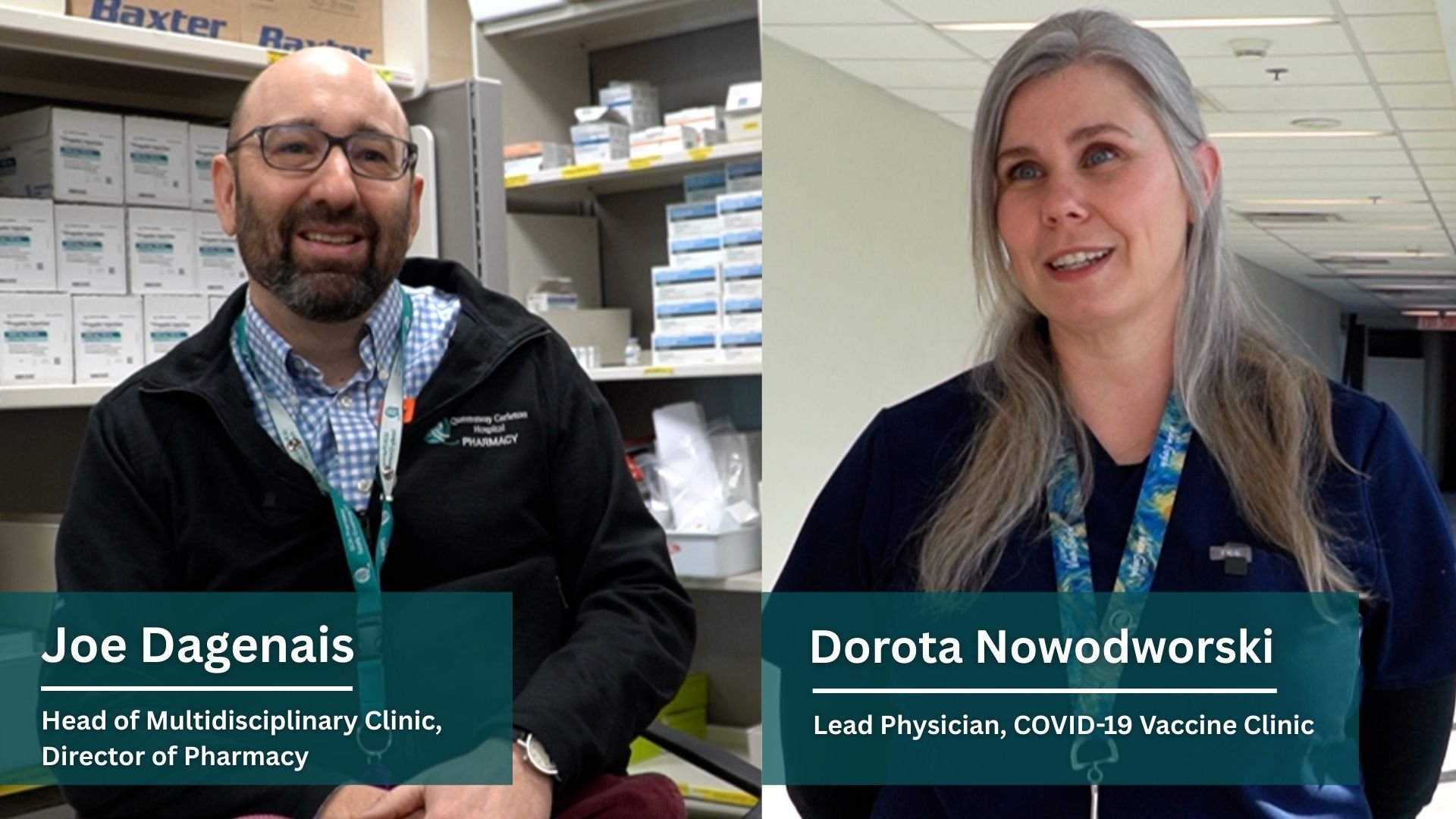
Speakers: Joe Dagenais (Head of the Multidisciplinary Clinic and Director of Pharmacy) and Dr. Dorota Nowodwoski (Lead Physician, COVID-19 Vaccine Clinic)
Dorota Nowodwoski:
We were seeing people dying. It was very scary time for us to be thinking that we could bringing it home to our families. And I do remember thinking when that vaccine came out that you know science came through and kind of saved us. And it definitely felt like a big big piece of hope that came through.
Joe Dagenais:
We found out at about November of 2020 when finally the vaccine was available for the world. That there was a, the plan from the ministry on how we would actually disseminate this to the population given that there was only so much of the vaccine available out there. So there was a very controlled environment. So we had found out from the ministry that Queensway Carleton Hospital along with TOH would be providing vaccine within the region and originally we had been only looking at doing staff and looking for the vaccinations for the administrations and then that soon expanded to an ask back in March of 2021 to actually open it up to the general public. We found that we could do it in the innovation room. And so we actually had the CPI group, the Continuous Performance Improvement group, Li Peckan was actually spearheading running the the model and the path of going through the vaccine clinic and we actually did trials and we had IPAC come down to make sure Infection Prevention Control to make sure that we were keeping enough distance. We were having difficulty with keeping that six-foot distance that everyone had to keep social distancing. And so we then moved to putting in barriers that we could get people closer together, but we wanted to do as many as we could at a time. And so after many trials and modeling it, we actually came up with a process for the vaccine clinic.
Dorota Nowodwoski:
It was a multi-disciplinary team that came together from pharmacy and logistics and physicians and nursing to as well as even booking to to put the clinic together. We were able to provide vaccines in retirement homes as well as to the general public as well as patients in the hospital. So we had sort of a multi-pronged approach to vaccinating patients around Ottawa.
Joe Dagenais:
And then that was just the clinic itself. And down here within pharmacy where we're at, just behind you is actually where we had a cage set up. And this cage actually had badge scanning to get in. There's a security system. Only certain texts were allowed to actually go in there cause that's where we actually had to store in this subzero was minus 80° freezer that we had had specifically from the ministry. We had to wear special gloves so we didn't get frostbite.
Dorota Nowodwoski:
It was very intense because it was a very political issue as well as there was concerns that vaccines could be stolen. Every vaccine was accounted for. Every really every drop was accounted for. We had special syringes to extract as much of the vaccine as possible, and it was quite a high security measure.
Joe Dagenais:
We actually had the RCMP come in and do a security assessment of us in determining because there was a lot of fear out there that people would be trying to intercept that vaccine and get it out there. It even came to the pl point where we actually had to have a way of disposing of the vaccine vials because there were reports out in the community of people taking those vaccine vials, filling them up with normal saline and selling them as COVID vaccine. There was such a high security around that. So when we actually had that prepared down here and sent up to the clinic, we actually initially had security would come and actually escort us up to the vaccine clinic where we'd actually store the vaccine in an automated dispensing cabinet so only certain people would actually have access to the vaccine.
Dorota Nowodwoski:
We used every single last vaccine because people really wanted it and it was in short supply. We had to think of ways to make sure that no vaccine went to waste and that was really important. So we had lists of people that still met the criteria because there were very strict criteria of who had to be rolled out at the beginning. We had a little room in the back where if we had somebody who was feeling faint, we'd had a bed available to us. That was also a good quiet space for anybody who may have neurodivergent qualities and had difficulty getting vaccines. So it was a nice quiet space that we could have their family in with them and and get that kind of thing done. We always sort of had a huddle at the beginning of the day to keep everybody up to date on the latest questions that patients may have and answers that they so everybody had consistent information. And also the QCH Foundation was very helpful. They enlisted several physicians and members of the community speaking different languages and making um promotional videos talking about the vaccine and explaining it so that it was expanded to people with different language backgrounds as well. I wanted everybody to feel like they had been part of something because they were part of something important. And so we made these pins I still wear mine on my lanyard that say prevent and protect in the year that that we were vaccinating which was 2021 with a little syringe and and then our QCH logo.
Joe Dagenais:
We were tasked with an objective and it seems insurmountable at the time, but when you come together collaboratively, the amount of different departments that were involved in here, even like we had EVS that were responsible for being up in that clinic and cleaning the chairs, a patient would get up, boom, they would be in there actually cleaning off the chairs and so you could always find a way to do it and everyone actually remained focused on what the objective was was to vaccinate as many people as we could and it was just absolutely amazing. The collaboration from physicians, nurses, EVS, registration played a a big part in this and their expertise and how they could actually expedite the registration process. Pharmacy, technicians, pharmacists. It was it was fabulous.
A Sense of Hope
On March 10, 2021, QCH opened its COVID-19 Vaccine Clinic, marking a significant moment in the pandemic response and offering a sense of hope.
Voices Featured
In the video, Joe Dagenais (Head of the Multidisciplinary Clinic and Director of Pharmacy) and Dorota Nowodwoski (Lead Physician, COVID-19 Vaccine Clinic) discuss planning the clinic, implementing security measures, and maximizing vaccine distribution.
The Impact
The QCH clinic supported the regional vaccine rollout and was part of multiple vaccine strike teams in retirement and long-term care homes across Ottawa. The clinic administered over 62,000 doses before closing in January 2022 when vaccines became more widely available in the community.